2 Player games : the Challenge
- 4.7
- Rating
- 100.00M
- Installs
- Free
- Price

 Analysis by App-foxy
I keep coming back to 2 Player games: the Challenge for one simple reason: it turns a single phone or tablet into a quick two-person arcade session. That sounds modest, but it changes the way I use a mobile game. Instead of asking a friend to install the same title, create an account, or wait through a long tutorial, I can place the device between us and start competing almost immediately. The game is free, made by JindoBlu, and sits firmly in the arcade category, but its real appeal is less about solo progression and more about sharing one screen.
That focus gives it a clear identity. I would not choose it as my main game for a long commute alone, and I would not expect a deep campaign from it. I would choose it when two people have a few spare minutes and want something active, simple, and competitive. The experience works especially well in those small gaps when a board game feels too involved and a normal multiplayer game feels too dependent on separate devices.
One device is the whole point
The central capability is local play for two people on the same device. In practice, that means the screen becomes a shared playing surface, with each participant controlling their own side or area. The arrangement removes several common barriers to mobile multiplayer: no matching with strangers, no need to compare hardware, and no waiting for another player to download anything before the contest begins.
You May Also Like

 AccuWeather: Weather Radar
AccuWeather Review: A Quick, Clear Forecast for Everyday Decisions
For everyday plans, the best forecast is the one you can understand quickly. AccuWeather makes rain timing, radar, and local conditions easy to act on, with a few trade-offs.

 Hill Climb Racing
Why Hill Climb Racing Still Turns Crashes Into One More Run
A tiny car, a bumpy hill and one more upgrade: Hill Climb Racing keeps resurfacing because its simple chaos makes every near-miss feel personal.

 AliExpress - Shopping App
AliExpress Makes Global Shopping Feel Personal, but Shoppers Bear the Risk
AliExpress turns a global marketplace into a pocket-sized discovery engine. Its reach is useful, its shopping loop compelling, and its trade-offs easy to miss.

 Lords Mobile: Kingdom Wars
Lords Mobile Is a Kingdom-Building Routine, Not a Quick Match
A case-by-case verdict on the building, battles, device demands, and social commitments that make Lords Mobile rewarding for some players and exhausting for others.

 PDF Scanner app - TapScanner
TapScanner Makes Paperwork Easier to Capture, Check, and Share
TapScanner makes scanning with a phone feel less like a rescue operation and more like a dependable step in getting work done. Its capture tools are useful, though not flawless.

 Block Blast!
 Shows How Much a Puzzle Game Can Leave Out
A quiet grid game shows why puzzle players increasingly value instant clarity, repeatable skill and low-pressure play—and where the genre still needs to catch up.
More From Our News Desk
View All News


I find that design more important than it first appears. Many mobile arcade games are built around a single player chasing a high score, while online multiplayer often brings connection issues, invitations, accounts, or uneven skill levels into the picture. Here, the competition is immediate and visible. I can see the other player react, notice when they are taking a risk, and celebrate or complain together when a round turns around at the last moment.
The short-description promise of two-player games is therefore not just a label. It describes the reason to install this particular title. The game is at its best when the phone is treated as a shared object rather than a private screen. That makes it a natural fit for friends sitting together, siblings sharing a device, or two people waiting somewhere with nothing else to do.
There is also a useful social effect: the game gives both players the same information at the same time. In an online match, the other person may be represented by a username, a delay, or a connection indicator. On one device, the result is much more direct. You can explain a rule by demonstrating it, and a new player can learn by watching the other person for a moment. I would still expect a little trial and error, but the shared screen makes that learning less intimidating.
What the shared screen changes
A single-device setup makes the game easy to start, but it also makes physical positioning matter. I get the best results when the device is laid flat or held where both players have a clear view. If one person is forced to lean across the other, the convenience disappears quickly. A larger phone or tablet can make the experience more comfortable, while a compact phone keeps it portable but may feel crowded during energetic play.
This is one of the less obvious trade-offs of local multiplayer. The game itself may be ready in seconds, but the people around it still need to arrange themselves. I recommend deciding where the device will sit before beginning a serious match. A stable surface is better than balancing it on a knee, especially when both players are tapping quickly. That small preparation prevents accidental movement from becoming part of the contest.
The format also makes fairness easier to judge. Both players use the same device, so differences in screen quality, battery condition, or network performance are not deciding the result. Skill and reaction become more prominent. For casual play, that is a strong advantage over games where one person has a newer phone or a more reliable connection.
How I approach a first session
When I introduce the game to someone new, I do not begin by explaining every possible rule. I let the first round act as a demonstration, then point out the controls that matter after the player has seen them in motion. This works better than turning a quick arcade session into a lesson. The shared format supports that approach because the experienced player can show the timing directly.
I also prefer to agree on the mood before starting. If both players want a relaxed laugh, I treat the opening rounds as experiments. If we are genuinely competing, I keep the device in the same position and avoid changing the setup between attempts. That consistency matters more than people expect; even a small change in how the phone is angled can affect how comfortably each side reaches its controls.
Because it is free to download, the barrier to trying it is low. The game includes in-app purchases priced at $6.99 per item, so I would check the purchase flow before handing the device to a child. The content rating is Everyone, which makes the game broadly suitable for family use, but an age rating does not remove the need for normal supervision around spending.
How it feels in everyday use
The strongest everyday scenario is a short wait with another person. Imagine two friends sitting in a café before an appointment, or siblings sharing a tablet while a family meal is being prepared. One person suggests a match, the device comes out, and the game fills the gap without requiring a full evening of attention. That is where I think the design earns its place: it creates a social activity from hardware that might otherwise be used by only one person.
It also works well after a longer game has ended. When everyone is tired of learning rules or managing a complicated setup, a quick arcade contest provides a clean change of pace. I can play a few rounds, put the device away, and return to the conversation. That stop-and-start quality is more useful to me than a game that demands a long uninterrupted session.
For families, the shared device can be an advantage because it sets a natural boundary. Two players are involved at once, rather than one person disappearing into a personal screen. Parents can observe what is happening, join a round, or help a younger player understand the controls. The Everyone rating supports that broad audience, although the competitive format can still produce frustration when one player loses repeatedly.
My practical tip is to rotate who starts or who chooses the first challenge. In a two-player game, a small advantage at the beginning can shape the mood of the whole session. Alternating roles keeps the experience from becoming a one-sided test, particularly when one person already has more experience with arcade controls. I would also stop while both players are still enjoying it; the format is strongest as a compact activity, not necessarily as an all-night commitment.
Where it beats usual arcade alternatives
Compared with a conventional solo arcade game, this title has a more immediate reason to be opened when someone else is nearby. A solo game can be excellent for personal practice, but it does not automatically create interaction. Here, the other player is part of the design from the beginning. That makes the game more useful at gatherings than an app built around one person’s score.
Compared with online multiplayer, the local format is simpler and more personal. There is no distance between the players, and the game does not depend on finding a suitable opponent at the right moment. The downside is equally clear: both people must be in the same place, and only two participants can share the intended setup. If my friends are in different cities, an online alternative is obviously more practical.
Compared with a physical card or board game, this is quicker to set up and easier to pack away. I do not need a table full of pieces or a rulebook before trying a round. The trade-off is that the phone remains the center of attention, and the experience may feel less tactile than moving cards, dice, or tokens. I see it as a companion to those games rather than a complete replacement.
Small habits that improve the experience
I get more from the game when I treat each session as a series of short contests instead of assuming that one match must carry the whole evening. This makes it easier to include players with different skill levels. A newcomer can have a few attempts without feeling that a single poor result defines the session, while an experienced player still has a reason to stay focused.
Another useful habit is to keep the device free from interruptions before beginning. A notification arriving across the shared screen can break concentration for both players, and reaching for the phone during a close round is awkward. I would not call this a flaw unique to the game; it is a consequence of using a personal device as a public game board. Still, planning around it makes the local format feel much smoother.
Finally, I would avoid judging the game by the amount of content expected from a large solo title. Its value comes from accessibility and repeatable social moments. If I want a story, character development, or a carefully paced single-player journey, I should choose another arcade game. If I want a fast challenge that another person can understand by watching, this one makes a stronger case.
Trade-offs worth considering before installing
The biggest limitation is also the defining feature: the game is built around two people using one device. That is excellent for face-to-face play and useless for a friend who is not physically present. Someone looking for online matchmaking, remote competition, or a large group experience should skip this and choose a game designed around those needs.
Screen size is another consideration. On a small phone, two players may need to hold their hands close together, and the shared view can feel cramped. A tablet offers more breathing room, but it is less convenient to carry around. I would try the game on the device I plan to share rather than assuming that every screen will feel equally comfortable.
The arcade structure can also expose differences in reflexes. A skilled player may dominate quickly, which is fun for a competitive pair but discouraging for a child or casual player. I would use informal rounds, switch sides when appropriate, and let beginners experiment without turning every attempt into a formal score. The game provides the contest; the people playing still control whether that contest feels welcoming.
In-app purchases are another reason to keep expectations clear. The game is free, but individual purchases cost $6.99 each. I would not describe the free entry point as a guarantee that every optional element will remain free. Before allowing a child to play independently, I would review the device’s purchase protections and explain that the app is free to start, not a blanket promise that every item costs nothing.
There is also a natural limit to replay value for players who prefer long-term progression. A local arcade challenge can remain entertaining because of rivalry, but the motivation comes mainly from improving against another person. If I am alone and want a structured reason to return every day, a progression-heavy alternative may hold my attention better. This game depends more on social context than on a personal collection of achievements.
Who will enjoy it most
I think the best audience is friends or relatives who enjoy quick competition and already share a room. It is particularly suitable for people who do not want to learn a complicated control scheme before having fun. The 4.7 average from around 663 thousand ratings and more than 100 million installs suggest that the simple idea has reached a very broad audience, though popularity does not change the need to match the format to your habits.
It is also a sensible choice for households with one spare device rather than two gaming phones. A tablet can become a small family activity during travel, a quiet afternoon, or a break between other plans. The Everyone rating makes it approachable across age groups, while the arcade category keeps the focus on active, immediate play rather than a long narrative commitment.
I would be more cautious about recommending it to someone who plays almost exclusively alone. The app may still offer value as a way to discover or practice its challenges, but its strongest reason to exist appears when another person is beside you. Likewise, players who dislike competitive pressure, shared screens, or short repeatable rounds may find the experience less satisfying than a solo puzzle game or a deeper arcade title.
Device compatibility is fairly broad: the current version is 7.12.4 and it supports Android 6.0 or later. That makes it accessible on many older Android devices, although the comfort of two-player use still depends on the physical screen and how responsive the device feels. I would think about ergonomics as much as operating-system support before deciding whether it is right for regular group play.
JindoBlu has kept the concept focused enough that the app is easy to explain to a friend: take one device, sit together, and compete. That clarity is its main strength. It does not need a complicated pitch, and it does not ask me to organize a networked event for a few minutes of entertainment. The same focus is why it will not satisfy everyone, but I prefer that honesty to a game that tries to serve every possible style at once.
My recommendation after using the shared format
I recommend 2 Player games: the Challenge when the real goal is to make two people interact around one screen. Its strongest feature is not a particular statistic or a long list of modes; it is the way local play removes the usual friction between “we should play something” and actually starting. The game is free, easy to bring into a casual situation, and broad enough for family use.
I would install it for travel, waiting rooms, family downtime, or a friendly rematch after dinner. I would not install it expecting an online community, a solo campaign, or the depth of a traditional console game. Those are not minor differences; they determine whether the app feels perfectly suited to the moment or completely misplaced.
For me, the deciding question is simple: will another person regularly be close enough to share the device? If the answer is yes, this arcade game can turn a spare phone or tablet into a surprisingly effective social activity. If the answer is no, its central design loses much of its value, and a solo or online alternative will probably serve better.
That makes the recommendation specific but strong. I like the game because it understands its job and performs it without demanding a large time commitment. Set the device somewhere both players can reach, agree on a relaxed way to handle uneven skill, keep purchases under control, and treat the rounds as quick shared challenges. Used that way, it is a practical little game for real-world moments when two people want something to do together.
FAQs for 2 Player games : the Challenge
01What is '2 Player games: the Challenge'?
'2 Player games: the Challenge' is a mobile app designed for both Android and iOS platforms. It offers a collection of mini-games that can be played by two players on the same device. The app is perfect for friendly competitions and is ideal for users looking to enjoy quick, fun games with friends or family.
02Do I need an internet connection to play?
No, '2 Player games: the Challenge' does not require an internet connection for most of its games. The app is designed to be played offline, making it convenient for users who want to enjoy games without worrying about connectivity issues. This makes it perfect for playing on the go.
03Are there any in-app purchases or ads?
Yes, the app contains ads, which can interrupt gameplay. However, users have the option to remove ads through in-app purchases. Additionally, some games or features within the app may be locked behind paywalls, offering users the choice to expand their gaming experience if they wish.
04What types of games are included in the app?
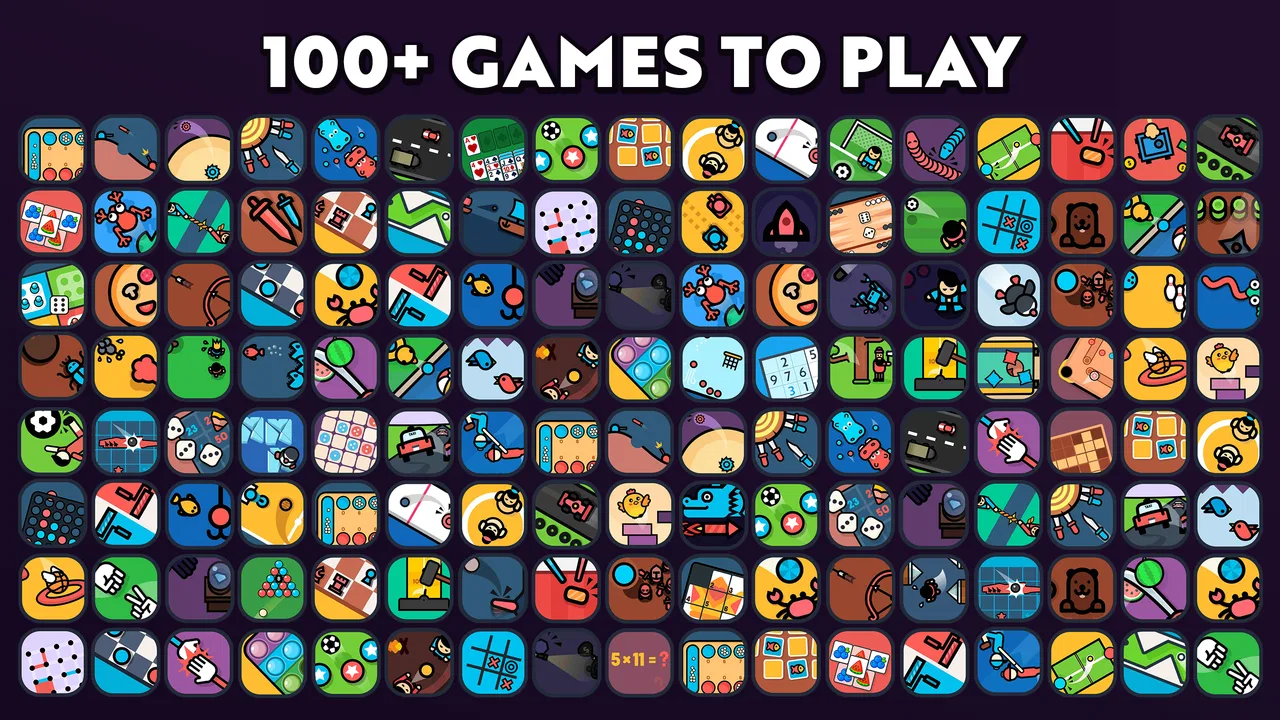
The app includes a variety of mini-games that cater to different interests and skill levels. These range from strategy and sports games to quick reflex challenges. Each game is designed to be easy to understand, ensuring players of all ages can enjoy the competitive fun without a steep learning curve.
05Is '2 Player games: the Challenge' suitable for children?
Yes, the app is generally suitable for children. The games are designed to be family-friendly, with simple controls and rules. However, parental guidance is recommended due to the presence of ads and potential in-app purchases. It's always a good idea to monitor the app usage to ensure a safe gaming environment for kids.
Pros
- Wide variety of games for all tastes.
- Simple
- intuitive user interface.
- Quick loading times enhance gameplay.
- Local multiplayer for shared fun.
- No internet required for most games.
Cons
- Limited online multiplayer options.
- Some games lack depth and complexity.
- Ads can be intrusive at times.
- Graphics may seem outdated to some.
- In-app purchases can be frequent.

2 Player games : the Challenge
Gallery